Repo Rate Hike: Should You Raise Your Home Loan EMI or Extend the Tenure?
By Sagar Saroy
On 7 October 2026, the RBI raised the repo rate by 25 basis points to 5.50%. It was the first hike since 2023.
If you have a floating-rate home loan, your interest rate will rise soon. And your bank may already have made a decision for you about what happens next. It just hasn't told you yet.
When rates go up, many lenders do not raise your EMI. They quietly extend your tenure instead. Same EMI, longer loan. It feels painless. This post explains why the effect of a repo rate hike on your home loan EMI deserves a closer look, and why the real cost is not the interest. It is the date your loan ends.
What the repo rate hike means for your home loan
The repo rate is the rate at which the RBI lends to banks. Most floating-rate home loans today are linked to an external benchmark, often the repo rate itself. When the repo rate rises, your loan rate rises with it at the next reset.
Your lender then has two ways to recover the extra interest:
- Raise your EMI and keep the original end date.
- Keep your EMI the same and add months to the end of the loan.
The second option is the one that happens quietly. Your monthly outflow does not change, so most borrowers never notice. Until they read a statement years later and find their loan ends long after they expected it to.
The numbers: higher EMI or longer tenure?
Here is a worked example. Take a fresh ₹50 lakh home loan for 20 years at 8.5%. The EMI is about ₹43,391.
A 25 basis point hike takes the rate to 8.75%. Here are your two choices:
| Choice | What changes | Extra cost |
|---|---|---|
| Raise the EMI | EMI goes to about ₹44,186 | ₹794 more a month |
| Extend the tenure | EMI stays at ₹43,391 | About 12 more months, and roughly ₹3.5 lakh more in total payments than raising the EMI |
Paying ₹794 more each month keeps the loan on schedule. Keeping the EMI unchanged costs you about ₹3.5 lakh more over the life of the loan.
That gap grows quickly if rates keep rising. Using the same loan, here is what happens to the tenure if the total increase reaches 50 or 75 basis points:
| Total rate rise | EMI needed to stay on schedule | Or, extra months at the old EMI |
|---|---|---|
| 0.25% | ₹44,186 (+₹794) | About 12 months |
| 0.50% | ₹44,986 (+₹1,595) | About 27 months |
| 0.75% | ₹45,793 (+₹2,402) | About 45 months |
Figures are illustrations for a new ₹50 lakh, 20-year loan, calculated with the standard EMI formula. Your own numbers will depend on your outstanding balance and remaining tenure.
The real cost is the date, not the interest
The interest matters. But the bigger risk hides in the end date.
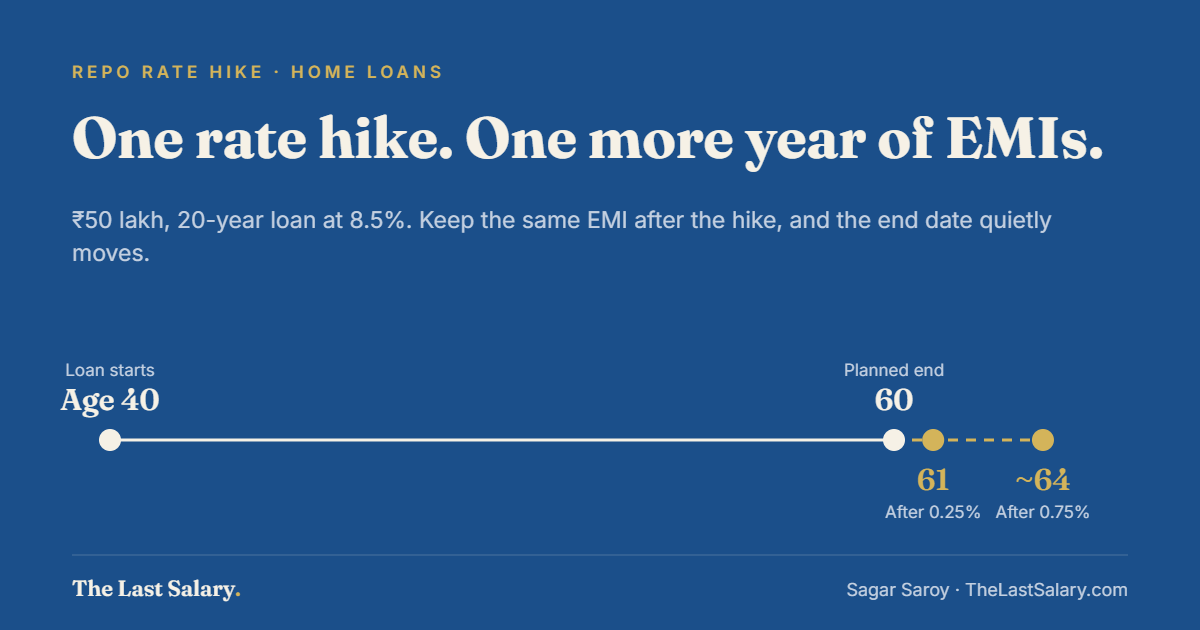
Suppose you took that loan at 40. It was meant to end at 60, around the time your Salary stops. One hike, and it ends at 61. If the total rise reaches 0.75%, it ends close to 64.
Those extra years are not paid from a Salary. They are paid from a pension, from a retirement corpus you now have to sell, or by your children.
A home loan has one job in retirement planning. It has to end before your last Salary does.
A loan with a fixed end date is a plan. A loan whose end date slides with every rate hike is only a hope.
Your rights under RBI rules
You do not have to accept a silent tenure extension. In August 2023, the RBI issued a framework for resetting floating interest rates on EMI-based loans. Under it, lenders must:
- Tell you clearly how a rate change affects your EMI and your tenure
- Give you the option to raise your EMI, extend your tenure, or combine the two
- Offer the option to switch to a fixed rate, as per their board-approved policy
- Allow you to prepay, in part or in full, at any point during the loan
In other words, the choice is yours. But only if you make it.
What to do now
- Find your latest loan statement and look at one line: the expected end date of the loan.
- Compare it with your planned retirement age. If the loan now ends after your last Salary, act now rather than at the next reset.
- Call or write to your lender and opt for a higher EMI. Ask for it in writing so the choice is recorded.
- Consider a part prepayment if you have savings earning less than your loan rate. On a fresh ₹50 lakh loan, a one-time prepayment of about ₹90,000 brings the loan back to its original EMI and end date.
- Recheck after every policy meeting. The MPC has shifted its stance to calibrated tightening, so further changes are possible.
The bigger lesson
Most people plan retirement around a number: the size of their corpus. Very few plan around a date: the month their fixed obligations end.
Yet the date is what decides how much income you actually need once the Salary stops. A retiree with no EMI needs far less monthly cash flow than one still paying for a home. That is the idea at the heart of my book, The Last Salary: Cash Flow, Not Corpus. Clear the obligations, then build income that pays you without being sold.
Your EMI is negotiable. Your last Salary date is not.
Frequently asked questions
Does a repo rate hike increase my home loan EMI?
It increases your interest rate at the next reset if your loan is linked to the repo rate or another external benchmark. Your lender may raise the EMI or extend the tenure instead, so check your statement to see which one happened.
Is it better to increase the EMI or extend the tenure?
If you can afford it, raising the EMI is almost always cheaper. In the example above, ₹794 more a month avoids about ₹3.5 lakh in extra payments and keeps the loan ending on time.
Can my bank extend my home loan tenure without asking me?
Under the RBI's 2023 framework on floating rate resets, lenders must inform you and give you the choice between a higher EMI, a longer tenure or a combination. If your tenure has been extended, you can ask your lender to switch to a higher EMI.
How do I know when my home loan will end?
Your latest loan statement or your lender's app shows the remaining tenure or expected closure date. Compare it with the date in your original sanction letter.
Should I prepay my home loan after a rate hike?
A part prepayment can bring your EMI and tenure back to the original schedule. It makes most sense when the money is sitting in savings that earn less than your loan rate, and when you still keep an adequate emergency fund.
Disclaimer: This article is for education only and is not financial advice. Please consult a certified financial expert before making investment decisions.