The Talmud's Rule of Thirds
By Sagar Saroy
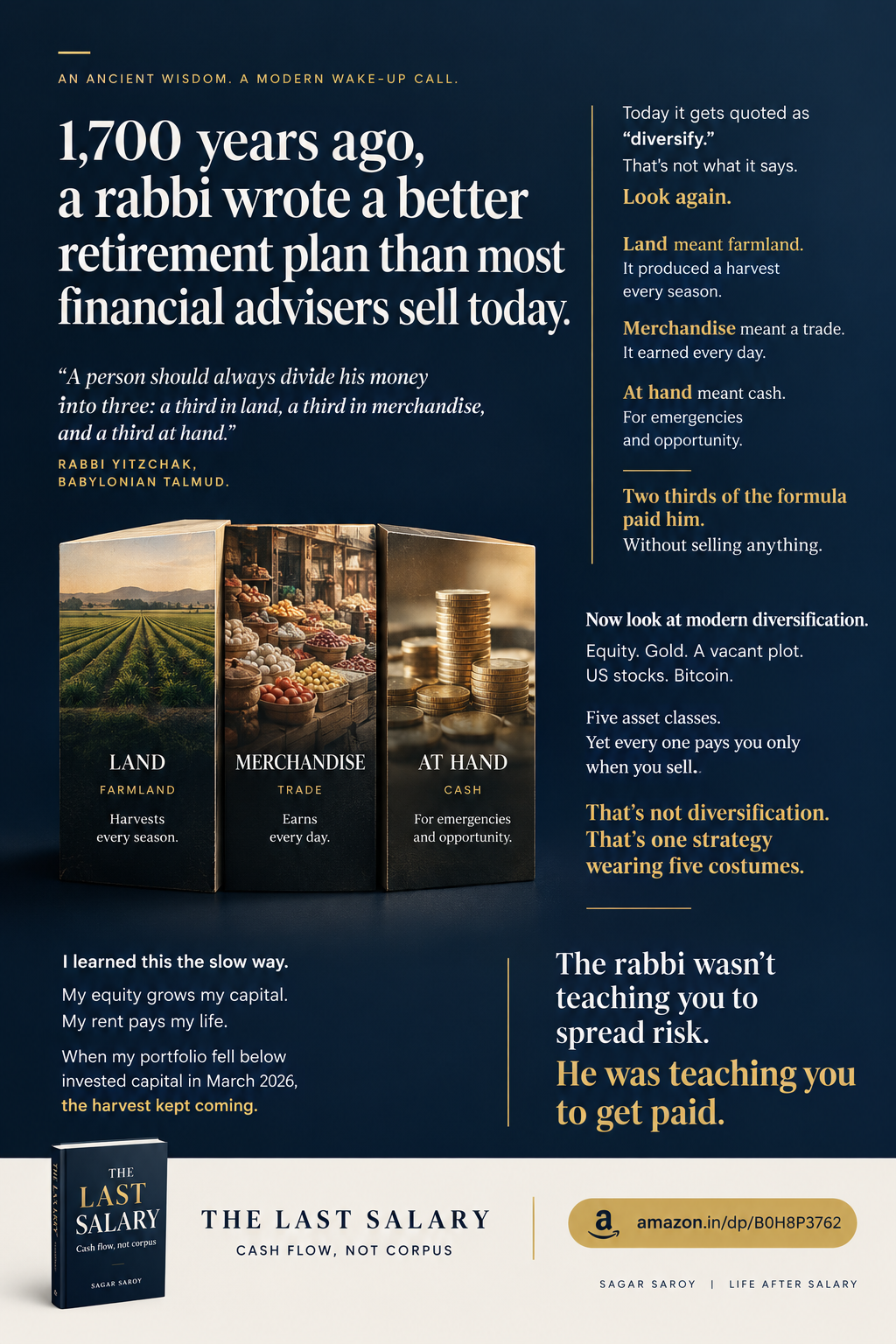
Seventeen centuries ago, a rabbi wrote a better retirement plan than most financial advisers sell today. It is known as the Talmud rule of thirds, and it fits in a single sentence.
"A person should always divide his money into three: a third in land, a third in merchandise, and a third at hand."
Rabbi Yitzchak, Babylonian Talmud, Bava Metzia 42a
Today this line is quoted as one of the oldest arguments for diversification. Finance professors cite it. Researchers have even tested simple equal splits like this against sophisticated portfolio models and found the simple split surprisingly hard to beat.
But reading it only as "diversify" misses what the rabbi was actually saying.
Read the rule of thirds again: two thirds of it was income
In his world, each third had a clear job.
- Land meant farmland. It produced a harvest every season. The household ate and earned without ever selling the field.
- Merchandise meant a trade. Goods moved every day, and the margin paid the family.
- At hand meant cash. It covered emergencies and let you seize an opportunity without being forced to sell anything else.
Two of the three thirds paid him regularly. The third made sure he was never a forced seller. Nothing in the formula required him to sell his land to buy bread.
That is not just a diversification rule. It is a cash flow rule.
Modern diversification: one strategy wearing five costumes
Now look at how most investors diversify today. Equity mutual funds. Gold. A plot of land bought as an investment. US stocks. Maybe some Bitcoin.
Five asset classes, with different charts, risks and stories. Yet they share one feature: each one pays you mainly when you sell it. Equity pays some dividends, but for most portfolios they are too small to live on.
Even "land" has changed meaning. The rabbi's land grew crops. A vacant plot grows only a price.
So an investor spread across five assets is still running one strategy: grow a number, then sell pieces of it to live. That works while prices cooperate. It hurts when you have to sell in a fall.
Why this matters most after your last Salary
While you earn a Salary, a falling market is an opportunity. After the Salary stops, a falling market is a bill.
A retiree drawing a fixed amount every month must sell more units when prices are low. If a fund's NAV falls 25%, raising the same rupees means selling about 33% more units. Those units are gone for good and cannot take part in the recovery.
In India, many retirees live this through systematic withdrawal plans (SWPs), which sell units every month whatever the market is doing. The rabbi's structure avoids the problem: the harvest and the trade pay the bills, so nothing is sold at a bad price.
My own version of the rule
I spent 29 years in corporate life. I reached financial independence at 45 through rental property and left corporate at 50.
I am not anti equity. I buy in the dips and book profits in the rallies. But I give my money separate jobs: my equity grows my capital, and my rent pays my life.
In March 2026 my equity portfolio fell below the capital I had invested. I did not sell a single unit. The rent kept arriving and the bills were paid. In the rabbi's language, the harvest kept coming while the market had a bad season.
How to apply the rule of thirds today
The lesson is not to split your money into exact thirds. It is to give each part of your money a job, and to make sure most of those jobs produce cash.
| The rabbi's third | Modern equivalent | Its job |
|---|---|---|
| Land | Rental property, REIT distributions, interest from bonds and deposits | Pays you every month without being sold |
| Merchandise | Your business or skill, plus equity in other businesses | Grows your capital and earning power over time |
| At hand | Bank deposits or overnight funds covering 6 to 12 months of expenses | Keeps you from ever becoming a forced seller |
Equity is today's version of owning merchandise, but with one difference. A trade paid the merchant daily, while equity usually pays you through price. So keep it for growth, not for next month's bills.
The Freedom Score test
To see how close you are to the rabbi's structure, calculate your Freedom Score:
Freedom Score = monthly income from assets that arrives without selling ÷ monthly expenses
Say your household spends ₹1,00,000 a month. You receive ₹40,000 in rent and ₹15,000 in interest. Your Freedom Score is ₹55,000 ÷ ₹1,00,000, or 55%.
At 100%, a market crash changes your net worth but not your life. Every rupee of income you add moves you closer.
The rabbi was teaching you to get paid
The Talmud's rule of thirds was never only about spreading risk. It was about making sure the household was paid, season after season, without selling the field.
Build the harvest before you need the bread.
I wrote The Last Salary: Cash Flow, Not Corpus to show how to build that harvest in India, step by step. Get the ebook on Amazon or visit TheLastSalary.com.
Frequently asked questions
What is the Talmud's rule of thirds?
It is a teaching by Rabbi Yitzchak in the Babylonian Talmud (Bava Metzia 42a): divide your money into three parts, a third in land, a third in merchandise and a third kept at hand as cash.
Is the Talmud rule of thirds still relevant for investors today?
Yes. Its lasting lesson is that most of your wealth should produce regular income, with a cash reserve so you are never forced to sell assets in a falling market.
Does "land" in the rule mean buying real estate?
In the rabbi's time, land meant farmland that produced a harvest. The modern equivalent is any asset that pays you without being sold, such as rental property, REITs or interest-bearing bonds, not a vacant plot held only for its price.
What is the Freedom Score?
The Freedom Score is monthly income from assets that arrives without selling, divided by monthly expenses. At 100%, your expenses are fully covered by income from what you own.
Should I split my money into exact thirds?
Not necessarily. The useful idea is giving your money three jobs: income, growth and protection. The right proportions depend on your situation, so consult a certified financial expert.
Disclaimer: This article is for education only and is not financial advice. Please consult a certified financial expert before making investment decisions.